
Jens Settergren
Pattern Recognition
November 6–18, 2026

Keishun-in Temple (within the Myoshinji Temple Complex)
11 Hanazonotera-no-nakacho, Ukyō-ku, Kyoto, Japan
November 6–18, 2026
VIP Reception: Sunday, November 8, 18:00–20:00
Royal Danish Embassy (Residence)
29-6 Saragaku-cho, Shibuya-ku, Tokyo, Japan
November 7 and 8, 2026
VIP & Press (By Invitation Only): Tuesday, November 17, 14:00–15:30
Asia Society: Art Breakfast with Jens Settergren
International House of Japan
5-11-16 Roppongi, Minato-ku, Tokyo, Japan
Talk (By Invitation Only): Tuesday, November 17, 8:00–9:30
11 Hanazonotera-no-nakacho, Ukyō-ku, Kyoto, Japan
November 6–18, 2026
VIP Reception: Sunday, November 8, 18:00–20:00
Royal Danish Embassy (Residence)
29-6 Saragaku-cho, Shibuya-ku, Tokyo, Japan
November 7 and 8, 2026
VIP & Press (By Invitation Only): Tuesday, November 17, 14:00–15:30
Asia Society: Art Breakfast with Jens Settergren
International House of Japan
5-11-16 Roppongi, Minato-ku, Tokyo, Japan
Talk (By Invitation Only): Tuesday, November 17, 8:00–9:30
ZETTAI is pleased to present Pattern Recognition, a solo exhibition by Danish artist Jens Settergren that extends his recent presentation at the KUMU Art Museum in Tallinn, Estonia. Spanning two venues in Japan, the Keishun-in Temple in Kyoto and the Royal Danish Embassy in Tokyo, the exhibition brings together hand-cut glass mosaics and lenticular prints to explore the intersection of historic craft, contemporary biotechnology, and digital screen culture.
Central to Pattern Recognition is Settergren’s translation of high-tech scientific imagery, such as brain scans, radar sweeps, neural networks, and microscopy, into permanent glass tesserae crafted by hand with hammer and chisel. By converting pixelated machine data into analogue tesserae “pixels,” the mosaics slow down and freeze images that otherwise exist in continuous digital circulation. Installed within the quiet sanctuary of Keishun-in Temple, Settergren blurs the boundary between past and present as scientific visualizations lose their clinical neutrality to inherit a sacred authority once reserved for religious iconography.
Drawing on Byzantine tradition, Settergren treats the mosaic as a portal, a medium originally understood as a direct window into the divine, and transfers this logic to realms normally beyond human sight, accessible only through technological mediation. Rendered through machine vision or radar, these hidden worlds confront us now as abstract configurations of light, geometry, and code. Historically, icons were also believed to actively look back at the worshipper; in a contemporary context, this non-human gaze reflects our relationship with algorithm-driven screens that continuously track, interpret, and predict their viewers. Rather than treating these abstract technological forms as mere clinical data, Settergren restores their sense of spiritual mystery. As art critic Kristian Vistrup Madsen notes: “Where science and modernism disenchanted the abstract image, Settergren imbues it once again with a mythical force. Because, of course, we believe in the power of these disenchanted images as we used to believe in God.”
In contemporary Japanese society, ancient spiritual traditions and hyper-advanced technology coexist as daily realities. At Keishun-in Temple, Settergren brings these two worlds into direct dialogue, using traditional Zen architecture as a framework for contemplation. Two lenticular prints mounted on simple scaffolds occupy the tokonoma alcoves in place of traditional hanging scrolls (kakemono). Utilizing a block LED font, these works create a linguistic bridge between the “scrolling” of physical parchment scrolls and of digital touchscreens. However, unlike a touchscreen interface, the analogue lenticular surface of Settergren’s screen cannot be swiped with a finger; instead, the viewer must physically move their bodies to read the shifting lines of typography, returning the gesture of “scrolling” to bodily movement. In the windowsill of the temple’s katōmado, a third lenticular print poem sits against the natural landscape. These lenticular texts also refer, both directly and indirectly, to the imagery presented in the mosaics. In this sense, they act as a poetic counterpart to the glass works, prompting a deeper inquiry into how contemporary images claim authority over our belief systems.
The exhibition extends to the Royal Danish Embassy in Tokyo, where the works shift from the quiet sanctuary of a temple into the embassy residence garden. Integrated directly into the stone pathways, three glass mosaics become part of the landscape’s physical architecture, encountered directly beneath the visitor’s feet.
Surrounded by foliage and stone, the mosaics enter a dialogue with the changing conditions of its surrounding Japanese garden landscape, continuously reacting to shifting daylight and the position of the viewer. Their hard, geometric surfaces and technologically derived imagery contrast with the organic textures of the garden; and while the scientific data frozen in the glass remains, the works themselves are fluid and animated by sunlight hitting the hand-cut tesserae. The works therefore never appear entirely fixed, and their perception remains in constant flux.
This setting introduces another dimension to Settergren’s exploration of technology and time. The residence exists as a venue facilitating diplomatic exchange, converging histories, and cultural dialogue, while its garden offers a slower, more elemental experience of time. Embedded within this environment, the technological motifs sit at the intersection of synthetic data and organic nature, juxtaposing the immediacy of the digital against the enduring rhythms of the landscape.
The works are displaced from conventional museum pedestals or fixed walls, and discovered almost incidentally beneath the visitor’s stride. This physical, ground-level encounter mirrors the lenticular prints at Keishun-in, where text reveals itself only through the viewer’s bodily movement. Across both venues, seeing becomes an intrinsically somatic act: the works summon the walking body to complete the image, grounding abstract, machine-generated vision within a tangible, spatial reality.
Central to Pattern Recognition is Settergren’s translation of high-tech scientific imagery, such as brain scans, radar sweeps, neural networks, and microscopy, into permanent glass tesserae crafted by hand with hammer and chisel. By converting pixelated machine data into analogue tesserae “pixels,” the mosaics slow down and freeze images that otherwise exist in continuous digital circulation. Installed within the quiet sanctuary of Keishun-in Temple, Settergren blurs the boundary between past and present as scientific visualizations lose their clinical neutrality to inherit a sacred authority once reserved for religious iconography.
Drawing on Byzantine tradition, Settergren treats the mosaic as a portal, a medium originally understood as a direct window into the divine, and transfers this logic to realms normally beyond human sight, accessible only through technological mediation. Rendered through machine vision or radar, these hidden worlds confront us now as abstract configurations of light, geometry, and code. Historically, icons were also believed to actively look back at the worshipper; in a contemporary context, this non-human gaze reflects our relationship with algorithm-driven screens that continuously track, interpret, and predict their viewers. Rather than treating these abstract technological forms as mere clinical data, Settergren restores their sense of spiritual mystery. As art critic Kristian Vistrup Madsen notes: “Where science and modernism disenchanted the abstract image, Settergren imbues it once again with a mythical force. Because, of course, we believe in the power of these disenchanted images as we used to believe in God.”
In contemporary Japanese society, ancient spiritual traditions and hyper-advanced technology coexist as daily realities. At Keishun-in Temple, Settergren brings these two worlds into direct dialogue, using traditional Zen architecture as a framework for contemplation. Two lenticular prints mounted on simple scaffolds occupy the tokonoma alcoves in place of traditional hanging scrolls (kakemono). Utilizing a block LED font, these works create a linguistic bridge between the “scrolling” of physical parchment scrolls and of digital touchscreens. However, unlike a touchscreen interface, the analogue lenticular surface of Settergren’s screen cannot be swiped with a finger; instead, the viewer must physically move their bodies to read the shifting lines of typography, returning the gesture of “scrolling” to bodily movement. In the windowsill of the temple’s katōmado, a third lenticular print poem sits against the natural landscape. These lenticular texts also refer, both directly and indirectly, to the imagery presented in the mosaics. In this sense, they act as a poetic counterpart to the glass works, prompting a deeper inquiry into how contemporary images claim authority over our belief systems.
The exhibition extends to the Royal Danish Embassy in Tokyo, where the works shift from the quiet sanctuary of a temple into the embassy residence garden. Integrated directly into the stone pathways, three glass mosaics become part of the landscape’s physical architecture, encountered directly beneath the visitor’s feet.
Surrounded by foliage and stone, the mosaics enter a dialogue with the changing conditions of its surrounding Japanese garden landscape, continuously reacting to shifting daylight and the position of the viewer. Their hard, geometric surfaces and technologically derived imagery contrast with the organic textures of the garden; and while the scientific data frozen in the glass remains, the works themselves are fluid and animated by sunlight hitting the hand-cut tesserae. The works therefore never appear entirely fixed, and their perception remains in constant flux.
This setting introduces another dimension to Settergren’s exploration of technology and time. The residence exists as a venue facilitating diplomatic exchange, converging histories, and cultural dialogue, while its garden offers a slower, more elemental experience of time. Embedded within this environment, the technological motifs sit at the intersection of synthetic data and organic nature, juxtaposing the immediacy of the digital against the enduring rhythms of the landscape.
The works are displaced from conventional museum pedestals or fixed walls, and discovered almost incidentally beneath the visitor’s stride. This physical, ground-level encounter mirrors the lenticular prints at Keishun-in, where text reveals itself only through the viewer’s bodily movement. Across both venues, seeing becomes an intrinsically somatic act: the works summon the walking body to complete the image, grounding abstract, machine-generated vision within a tangible, spatial reality.
Featured Works

Ghost, 2026

Emotional Index, 2025

World Brain, 2023

Oracle, 2026
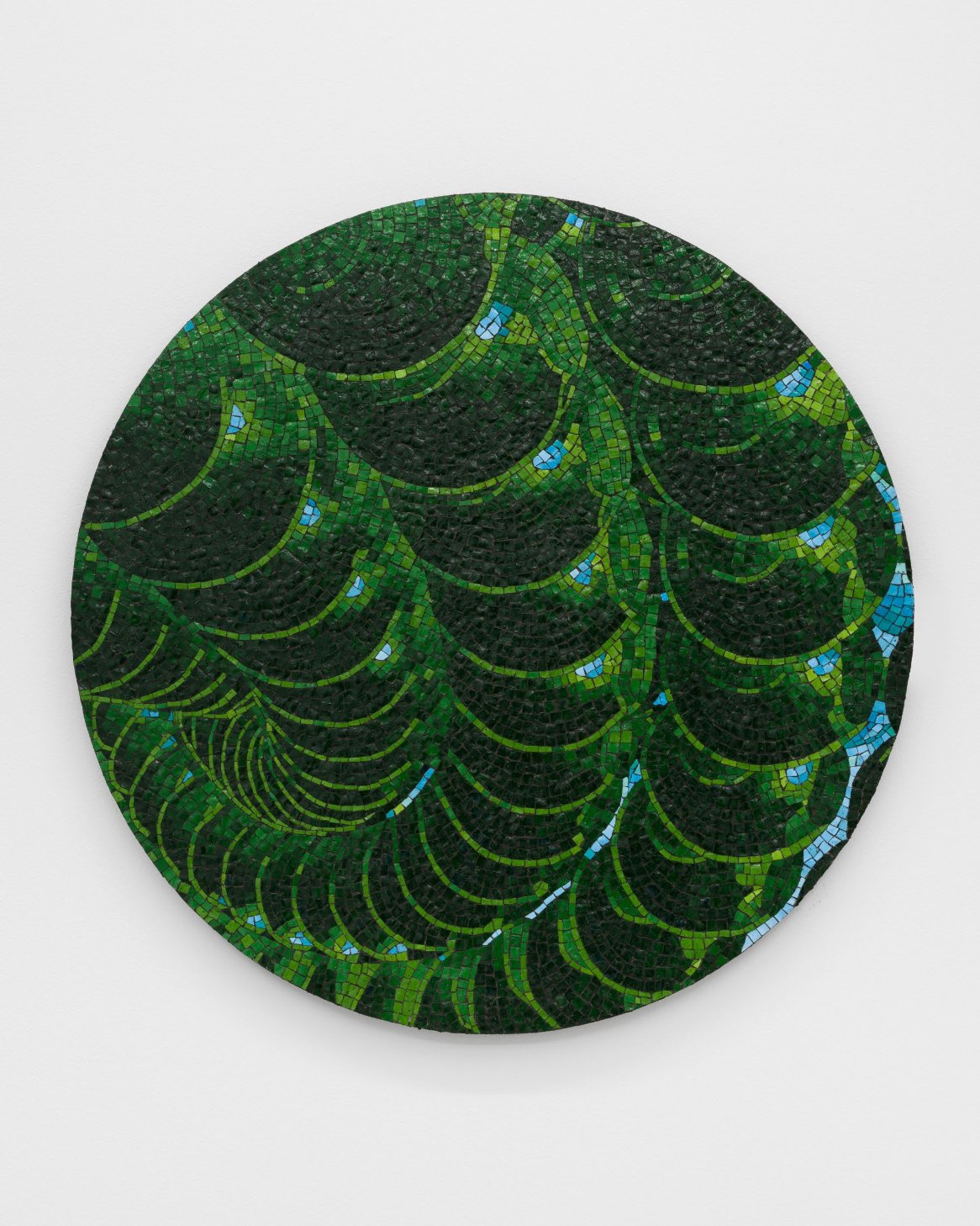
Orbs, 2026

Architect, 2026
About the Artist

Jens Settergren (b. 1989) is a Danish artist whose work dives into visual culture, unraveling how images seduce, deceive, and structure our desires and fears. Familiar symbols, commercial aesthetics, and everyday objects are displaced into unfamiliar contexts, subverting dominant narratives and revealing the hidden forces that influence how we perceive the world. Using video, photography, sculpture, sound, and digital animation, Settergren creates immersive experiences where the boundary between the organic and synthetic fades into a hypnotic ambiguity.
In his practice, Settergren reflects on how technology shapes our comprehension of the natural world, often challenging the role that contemporary images play in shaping societal beliefs. His multifaceted works blur the distinctions between the real and the imagined, the biological and the mechanical. Rather than offering clear answers, each piece invites viewers to engage with the complexities of modern existence, particularly the unexpected and sometimes unsettling ways in which nature and technology coexist.
Settergren graduated from the Jutland Academy of Fine Arts in 2016. He has exhibited extensively across Denmark at prominent venues, including SMK – The National Gallery of Denmark, MAPS Museum of Art in Public Spaces, and Copenhagen Contemporary. Internationally, his work has been presented at the KUMU Art Museum (Tallinn), Die Raum (Berlin), Haus der Kulturen der Welt (Berlin), Forum des images (Paris), and Art Sonje Center (Seoul). Recent exhibitions include Fertile at the Vejle Art Museum (2026), Milk Plus at Viborg Kunsthal (2024), and Multitude & Singularity at Maison du Danemark, Paris (2024). He also participated in Rencontres Internationales at the Louvre (2021) and Grave Monuments at Art Sonje Center (2021).
Settergren‘s work is included in the collections of SMK – The National Gallery of Denmark (Statens Museum for Kunst), the Danish Arts Foundation, MAPS Museum of Art in Public Spaces, and the Copenhagen Municipality among others.
In his practice, Settergren reflects on how technology shapes our comprehension of the natural world, often challenging the role that contemporary images play in shaping societal beliefs. His multifaceted works blur the distinctions between the real and the imagined, the biological and the mechanical. Rather than offering clear answers, each piece invites viewers to engage with the complexities of modern existence, particularly the unexpected and sometimes unsettling ways in which nature and technology coexist.
Settergren graduated from the Jutland Academy of Fine Arts in 2016. He has exhibited extensively across Denmark at prominent venues, including SMK – The National Gallery of Denmark, MAPS Museum of Art in Public Spaces, and Copenhagen Contemporary. Internationally, his work has been presented at the KUMU Art Museum (Tallinn), Die Raum (Berlin), Haus der Kulturen der Welt (Berlin), Forum des images (Paris), and Art Sonje Center (Seoul). Recent exhibitions include Fertile at the Vejle Art Museum (2026), Milk Plus at Viborg Kunsthal (2024), and Multitude & Singularity at Maison du Danemark, Paris (2024). He also participated in Rencontres Internationales at the Louvre (2021) and Grave Monuments at Art Sonje Center (2021).
Settergren‘s work is included in the collections of SMK – The National Gallery of Denmark (Statens Museum for Kunst), the Danish Arts Foundation, MAPS Museum of Art in Public Spaces, and the Copenhagen Municipality among others.